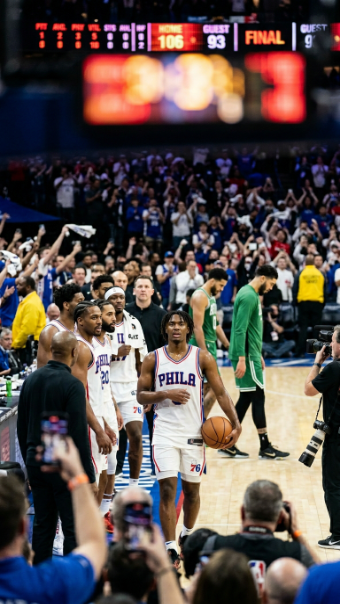
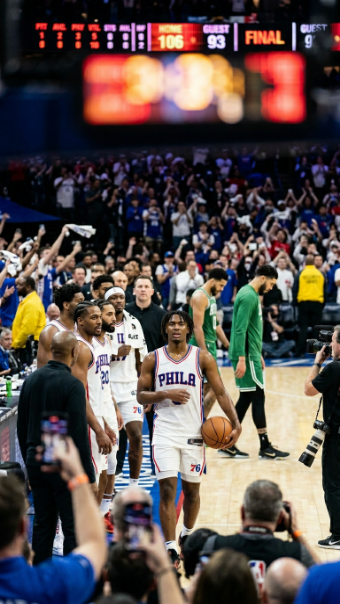
Tyrese Maxey leads a composed Philadelphia response as the first-round Eastern Conference series heads back to Boston tied 3-3.
PHILADELPHIA — The Philadelphia 76ers dragged one of the NBA’s most familiar playoff rivalries into another decisive night, defeating the Boston Celtics 106-93 on Thursday to force Game 7 in their first-round Eastern Conference series.
The win at Xfinity Mobile Arena tied the series 3-3 and sent it back to TD Garden, where Boston will host Philadelphia on Saturday, May 2, with a place in the conference semifinals at stake. For a Celtics team that had held a 3-1 series lead, the loss turned what once looked like a controlled path forward into a tense, single-game test. For the 76ers, it was a continuation of a late-series revival built on sharper defense, steadier guard play and renewed belief after absorbing heavy defeats earlier in the matchup.
Tyrese Maxey led Philadelphia with 30 points, setting the tone with speed, shot-making and repeated attacks that forced Boston’s defense into rotation. Paul George added 23 points, giving the 76ers a second perimeter scorer capable of punishing space. Joel Embiid, still the gravitational center of Philadelphia’s offense even when his own shooting rhythm came and went, contributed 19 points and 10 rebounds, anchoring the interior and creating room for others through his presence in the paint and at the elbows.
The final margin reflected Philadelphia’s control more than any late drama. Boston led briefly, but the 76ers seized the game across the middle two quarters, outscoring the Celtics 62-40 over that stretch and turning a narrow contest into a double-digit advantage. By the early stages of the fourth quarter, the Celtics had removed several starters, a signal that coach Joe Mazzulla was looking ahead to the series finale rather than chasing a game that had slipped away.
Philadelphia’s response was notable because of the context. The 76ers had been beaten badly twice in the series and looked vulnerable after Boston’s size, shooting and playoff experience overwhelmed them in earlier games. But after staying alive with a road victory in Game 5, Philadelphia returned home with greater urgency and played with the structure of a team that had solved at least part of Boston’s formula.
Maxey was central to that shift. His ability to accelerate before Boston’s defense could get set changed the rhythm of the game. When the Celtics gave him space, he rose into jumpers. When they pressed higher, he turned the corner. When help arrived, he moved the ball quickly enough to keep Philadelphia’s offense from stalling. In a series that has often tilted on half-court execution, Maxey’s pace gave the 76ers the open-floor energy they needed.
George’s contribution was just as important. Acquired to give Philadelphia another veteran scorer and two-way wing, he delivered the kind of playoff performance the 76ers needed beside Maxey and Embiid. His outside shooting stretched Boston’s defense, while his defensive assignments helped the 76ers limit the clean looks that usually sustain the Celtics’ offense. Philadelphia did not need George to dominate every possession. It needed him to make Boston pay for loading up elsewhere, and he did.
Embiid’s night was less about efficiency than influence. Boston’s defense remained physical with him, and he did not control the game simply by scoring. But his rebounding, passing and defensive positioning mattered. When he drew extra attention, Philadelphia’s guards and wings found better lanes. When Boston tried to play through the middle, he made those possessions crowded and uncomfortable. The 76ers’ best stretches came when Embiid functioned not only as a scorer, but as a hub.
Boston, by contrast, struggled to generate the offensive flow that helped it build the series lead. The Celtics shot 42 percent from the field and 29 percent from three-point range, numbers that left them short of the efficiency required against a Philadelphia team playing with momentum. Jaylen Brown and Jayson Tatum had moments, but neither imposed control long enough to halt the 76ers’ surge. Boston committed 13 turnovers and repeatedly found itself attacking late in the shot clock or settling for difficult looks.
The Celtics’ issues were especially pronounced in the third quarter, when Philadelphia held them to 14 points and pushed the game toward separation. What had been a competitive first half became a test of Boston’s patience, and the Celtics did not respond with the precision they needed. The 76ers defended with greater urgency at the point of attack, fought through screens and forced Boston into possessions that looked disconnected.
For Boston, the result sharpened questions that will follow the team into Game 7. The Celtics still have home court, a deeper record of postseason experience and the advantage of playing before their own crowd. They also have the burden of a missed closeout opportunity. Teams that lead 3-1 and fail to finish a series often face more than tactical adjustments. They face the psychological weight of momentum moving in the opposite direction.
Mazzulla and his players will have to decide how much of Game 6 was a temporary lapse and how much reflected a series that has changed. Boston’s offense has been most dangerous when the ball moves quickly from Tatum and Brown into the corners, forcing defenses to choose between protecting the paint and giving up threes. Philadelphia disrupted that balance on Thursday, staying connected enough to contest shooters while still crowding driving lanes.
The 76ers will enter Game 7 with a different challenge. They have now won two straight, but closing a series in Boston is a far more difficult task than extending one at home. TD Garden will offer a hostile environment, and the Celtics will have the chance to reset after a performance they will view as far below their standard. Philadelphia’s path will again depend on discipline: limiting turnovers, controlling defensive rebounds and keeping Maxey in positions where he can attack before Boston’s defense settles.
Game 7 also places the rivalry back where it often seems to belong: under maximum pressure. Celtics-76ers playoff meetings carry decades of history, but this version is defined by modern questions. Can Boston’s star-wing foundation withstand a sudden shift in momentum? Can Philadelphia’s rebuilt core produce one more composed performance away from home? Can Embiid, Maxey and George maintain enough balance to overcome Boston’s depth and experience?
The winner will advance to face the New York Knicks in the Eastern Conference semifinals, but Thursday’s result ensured that neither team will get there cleanly. Boston must repair an offense that looked hesitant and a defense that could not keep Maxey out of rhythm. Philadelphia must prove that its two-game response is sustainable, not merely a survival run.
For the 76ers, Game 6 was not just a victory. It was evidence that the series is no longer being played on Boston’s terms. Philadelphia dictated tempo, won the middle quarters, defended with force and found enough scoring beyond Embiid to keep the Celtics chasing. That formula may not guarantee anything in Game 7, but it has given the 76ers what seemed unlikely only days ago: one game, on the road, to finish a comeback and reshape the Eastern Conference bracket.
The Celtics still have the venue and the season-long résumé. The 76ers now have the momentum. On Saturday night in Boston, one of them will have the next round, and the other will have an offseason shaped by a series that slipped into sudden danger.