Electric cars are becoming cheaper, cleaner and more capable, but for many consumers the decisive question remains simple: where, how long and how reliably can they charge?
The electric vehicle has solved many of the problems that once made it seem like a niche product. Batteries last longer. Driving ranges have improved. More models are available across more price segments. Automakers are investing heavily. Governments continue to use regulation, incentives and infrastructure plans to push transport away from fossil fuels. Yet for millions of potential buyers, one anxiety still sits between curiosity and commitment: charging.
The worry is not always about the car itself. It is about the life around the car. A gasoline driver rarely plans a week around refueling. Stations are visible, standardized and familiar. The transaction is fast, and the social expectation is clear: pull in, fill up, leave. Electric vehicles ask drivers to learn a different rhythm. Charging can be done at home, at work, at a supermarket, along a highway or at a public fast-charging station. That flexibility can be convenient for owners who have reliable access. But for those who do not, it can feel like uncertainty disguised as progress.
The global charging network is expanding quickly. The International Energy Agency said public charging points have doubled since 2022 to more than 5 million worldwide. Ultra-fast chargers are also becoming more common, and governments from Europe to North America to Asia are investing in highway corridors and urban charging networks. But the IEA has also warned that public charger deployment has not kept pace with electric vehicle growth in some markets, including the United States and the United Kingdom. The result is uneven confidence: one driver may treat home charging as effortless, while another sees public charging as a daily risk.
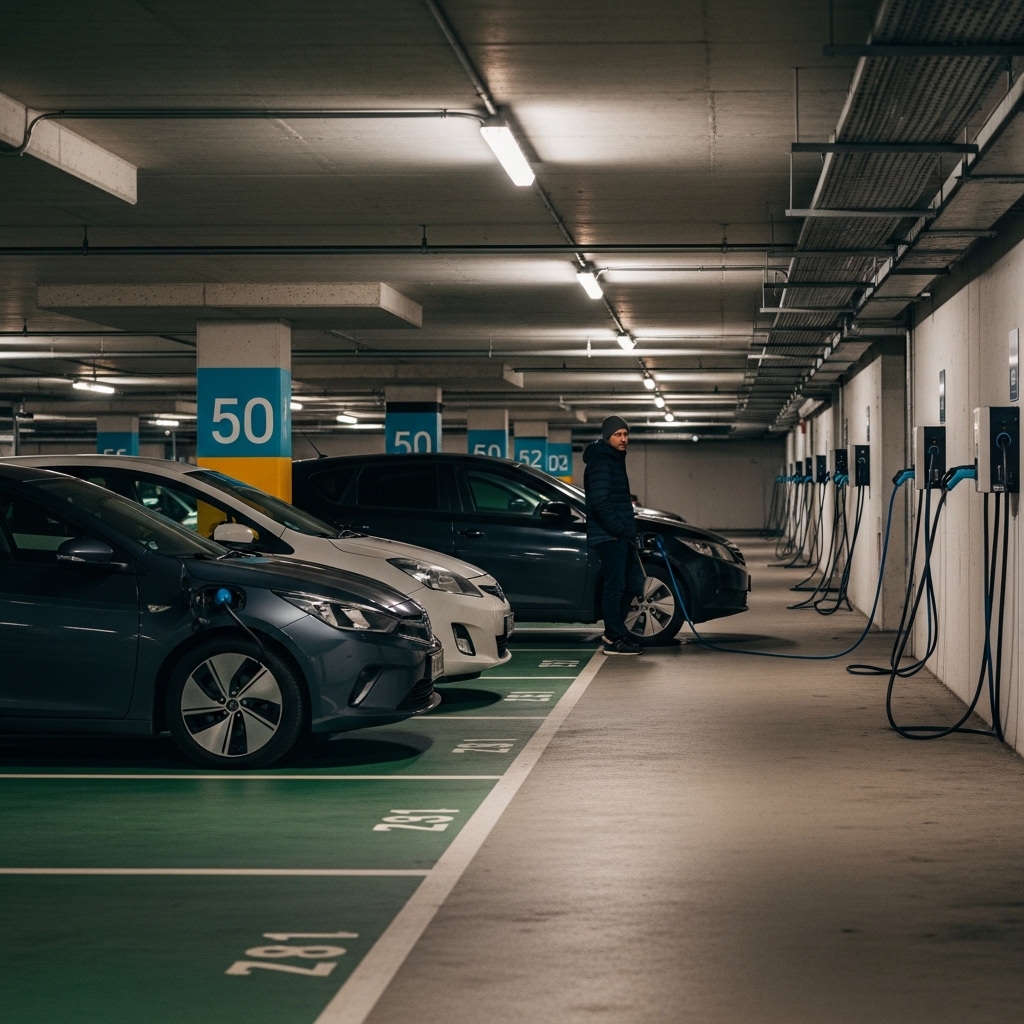
That divide is central to understanding EV hesitation. For homeowners with a driveway, garage or assigned parking space, an electric car can be easier to use than a gasoline car. The vehicle charges overnight while the owner sleeps. The morning begins with a full battery. Most daily trips require no public charging at all. For apartment dwellers, renters, urban residents without parking, delivery workers and people who travel long distances, the experience can be very different. They must depend on chargers they do not control.
This is why charging is not only an infrastructure issue. It is a housing issue, a workplace issue, a city-planning issue and an equity issue. The people most ready to benefit from lower operating costs may not have the easiest access to overnight charging. A family in a suburban house can install a charger and take advantage of cheap off-peak electricity. A renter in a dense city may have to circle for an available public station, pay higher fast-charging prices and wait in the car. The same vehicle can feel liberating to one household and inconvenient to another.
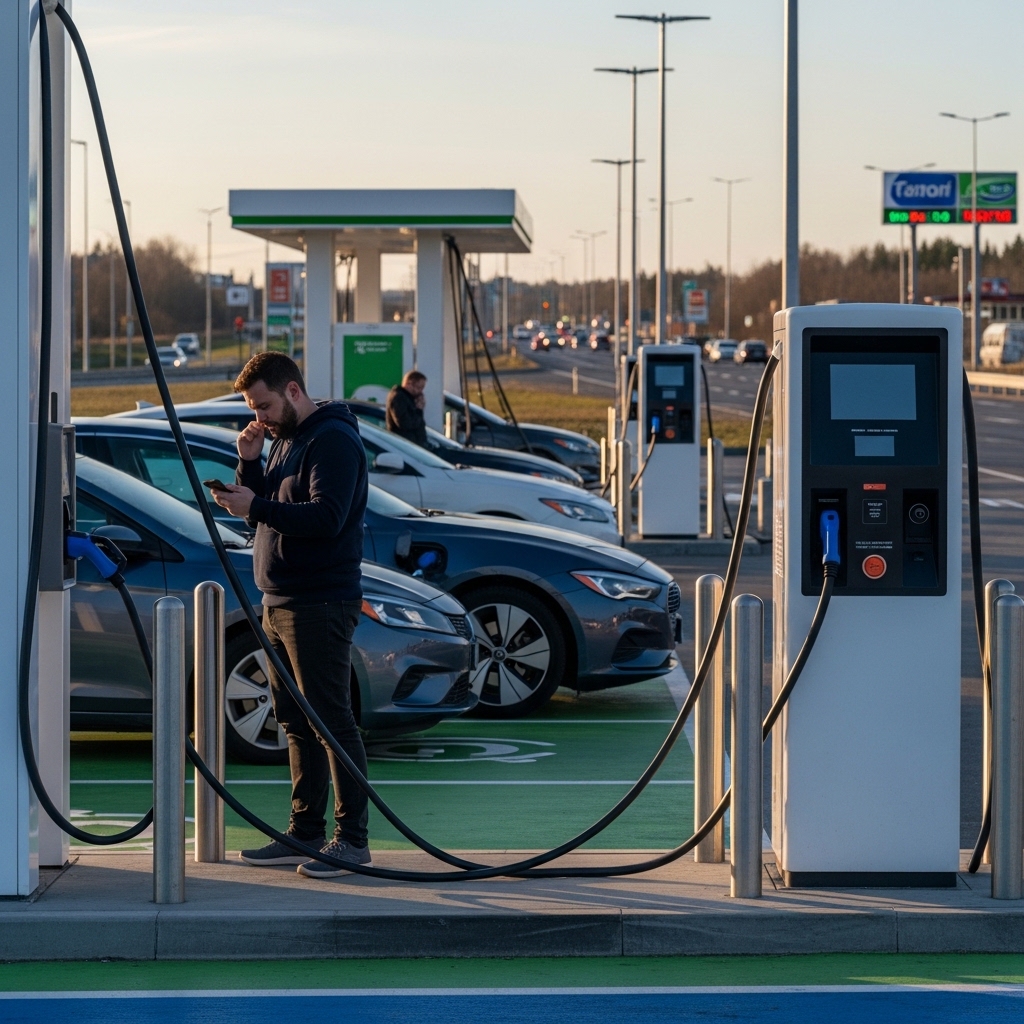
Reliability has become one of the industry’s most sensitive problems. Public charging does not need to be merely present; it needs to work. Drivers complain about broken stalls, payment systems that fail, apps that show chargers as available when they are occupied or offline, cables that do not connect properly, charging speeds lower than advertised and stations placed in poorly lit or inconvenient locations. A failed fuel pump at one gasoline station is annoying. A failed charger during a long trip can become a serious delay.
There are signs of improvement. J.D. Power’s 2025 U.S. Electric Vehicle Experience Public Charging Study found that the share of drivers who visited a public charger but could not charge fell to 14 percent, down from 19 percent in 2024, according to industry reporting on the study. But the same research also pointed to falling satisfaction because drivers felt public charging had become too expensive. This captures the current stage of the EV transition: the network is improving, but expectations are rising faster.
Cost complicates the picture. Electric vehicles are often cheaper to run when charged at home, especially where off-peak electricity rates are available. But public fast charging can be far more expensive than home charging and, in some cases, can narrow the cost advantage over gasoline. For buyers calculating total ownership costs, this matters. The promise of saving money becomes less persuasive if the driver expects to rely heavily on commercial charging networks.
Charging speed is another psychological barrier. Even when fast chargers are available, charging is rarely as quick as refueling with gasoline. Some drivers adjust easily, treating charging time as a break for coffee, food or rest. Others see it as lost time. The difference often depends on lifestyle. A commuter who drives predictable distances may hardly notice charging time. A salesperson, taxi driver, parent on a tight schedule or rural traveler may experience every additional minute as friction.
The industry often describes this problem as “range anxiety,” but that phrase can be misleading. Many modern EVs offer enough range for ordinary daily driving. What drivers fear is not only running out of battery. They fear arriving at a charger and finding it broken, full, slow, incompatible, expensive or unsafe. It is less range anxiety than charging uncertainty.
Standardization may help reduce that uncertainty. In North America, several automakers have moved toward access to Tesla’s charging connector and Supercharger network, a shift expected to improve confidence by giving more drivers access to a widely regarded fast-charging system. In Europe and China, different standards and stronger public policy have shaped charging deployment in other ways. But hardware compatibility is only one part of the solution. Drivers also need transparent pricing, reliable maintenance, simple payments and accurate real-time information.
The comparison with smartphones is useful but imperfect. People learned to charge phones every night because electricity was everywhere and the device became essential. Electric cars are harder. They require more power, more space, heavier infrastructure, grid planning and often local permitting. A phone charger can be placed on a bedside table. A fast charger may need upgraded electrical capacity, construction approvals, parking access and a business model that works even before utilization is high.
The business model remains difficult in many locations. Charging operators need enough customers to justify investment, but drivers need enough chargers before they feel confident buying EVs. This chicken-and-egg problem is especially acute outside wealthy urban areas and busy highway corridors. Rural regions, lower-income neighborhoods and smaller towns risk falling behind, creating a geography of confidence and doubt.
Governments are trying to close the gap. Public subsidies, charging mandates, building-code reforms and highway charging programs are intended to make the network more visible and dependable. But policy can move slower than consumer perception. A driver making a purchase decision today may not be comforted by a charger promised two years from now. Trust is built not by announcements, but by repeated successful charging experiences.
Automakers also have a role. Selling an EV is no longer just selling a vehicle. It is selling an ecosystem. Buyers need clear explanations of home charging installation, public charging access, battery management, winter performance, trip planning and realistic charging times. Confusion at the dealership can become hesitation at the point of sale. A customer who understands charging may become confident. A customer who hears vague assurances may walk away.
The strongest argument for EV adoption remains the experience of many current owners. Those with reliable home charging often report that the routine becomes easier than gasoline ownership. They stop visiting fuel stations. They charge during low-demand hours. They enjoy quiet acceleration and lower maintenance needs. For them, charging is not the obstacle critics describe. It is one of the benefits.
But the next wave of buyers may be harder to convince than the first. Early adopters were more willing to tolerate inconvenience, learn new systems and accept limitations. Mass-market consumers are less forgiving. They do not want to become infrastructure experts. They want transportation that works. To reach them, charging must become boring in the best possible way: predictable, visible, fast enough, fairly priced and dependable.
The future of electric mobility will not be decided only by battery chemistry or vehicle design. It will be decided in parking garages, apartment complexes, highway rest stops, supermarkets, workplaces and city streets. It will depend on whether charging becomes part of ordinary life or remains a source of planning anxiety.
The electric car is ready for more drivers than ever before. The charging experience is still catching up. Until it feels as simple and trustworthy as the fuel system it is meant to replace, many consumers will continue to stand at the edge of the transition, interested but unconvinced.