
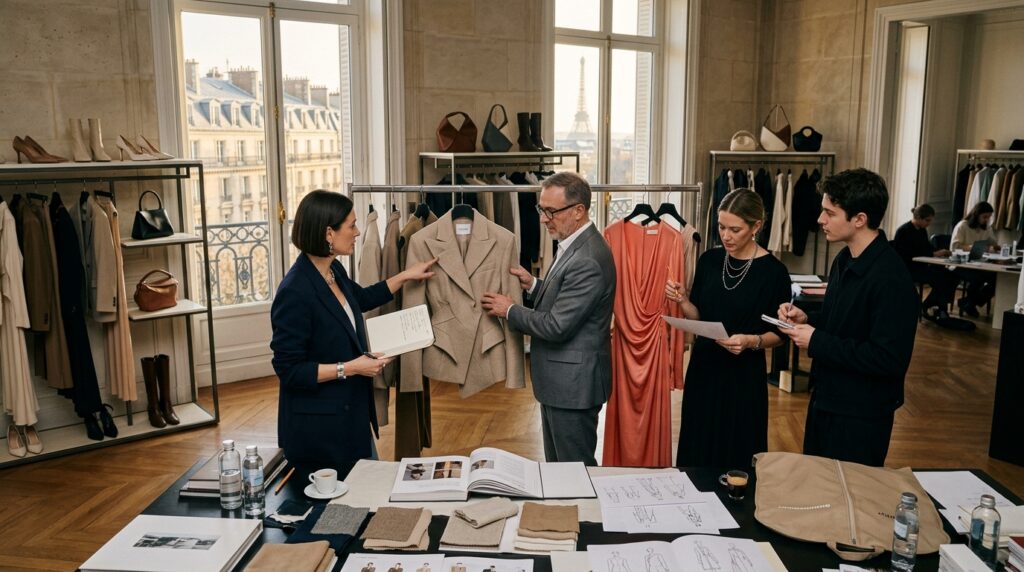
From Chanel and Dior to Loewe, a series of high-stakes creative handovers is reshaping the luxury conversation, with executives, buyers and consumers watching for clues about the silhouettes, accessories and visual codes that could define the next phase of global fashion.
Spring 2026 has become one of the most closely watched fashion seasons in years, not simply because of the clothes on the runway, but because so many of the industry’s biggest houses are using the season to introduce new creative leadership or cement freshly launched visions.
At the center of the conversation are Chanel, Dior and Loewe, three labels whose influence extends far beyond the front row. When houses of that scale change designers, the effects rarely stop at one collection. They can alter the direction of luxury retail, reset the tone of beauty campaigns, shift the accessory market and eventually filter into how mass consumers dress. That is why the current season has become a flashpoint for the broader lifestyle and fashion world: the debuts are not just symbolic moments of succession, but early signals of what the industry may look like next.
The attention is justified by the names involved. Chanel has entered a new era under Matthieu Blazy, the Belgian designer appointed as artistic director after Virginie Viard’s departure. Chanel’s official materials for Spring-Summer 2026 and Métiers d’art 2026 confirm Blazy as the creative force behind the collections, with the house framing his arrival as the beginning of a distinct chapter. Business of Fashion has noted that Blazy is the first external designer to lead Chanel since Karl Lagerfeld, a fact that underscores both the scale of the opportunity and the pressure attached to it. :contentReference[oaicite:0]{index=0}
Dior, meanwhile, has become a focal point of anticipation under Jonathan Anderson. The house’s official Spring-Summer 2026 ready-to-wear page and Spring-Summer 2026 couture materials identify Anderson as creative director and present the new collections as a forward-looking re-reading of Dior heritage. LVMH has also highlighted his debut couture collection, emphasizing the symbolic importance of his arrival at one of luxury’s most commercially powerful maisons. :contentReference[oaicite:1]{index=1}
At Loewe, the transition is different in tone but no less consequential. The Spanish house has officially announced Jack McCollough and Lazaro Hernandez, the duo behind Proenza Schouler, as its new creative directors. Their appointment follows the highly influential Loewe era shaped by Jonathan Anderson, whose tenure transformed the brand into one of luxury’s most culturally resonant labels. The challenge for the new duo is therefore unusually delicate: preserve Loewe’s reputation for craft, wit and object-driven desirability while building a language that feels recognizably their own. :contentReference[oaicite:2]{index=2}
Taken together, these moves help explain why Spring 2026 feels less like a normal runway cycle and more like a referendum on the future of big-house fashion. Vogue Business described Paris Fashion Week Spring/Summer 2026 as a season defined by an unprecedented wave of debuts, with designers navigating the difficult task of balancing novelty and heritage. That balancing act is now central to the luxury business. Conglomerates want creative renewal, but not at the cost of alienating core customers. Designers are expected to bring personality, but also commercial clarity. The debut collection has become the moment when those competing demands are most visible. :contentReference[oaicite:3]{index=3}
That is why every detail of these shows is being dissected far beyond traditional fashion media. A debut is no longer judged only on taste or technical execution. It is also read for what it says about brand strategy. Does the new designer lean into archival codes or reject them? Does the runway privilege clothes or handbags? Are the silhouettes built for editorial fantasy, social media circulation or retail conversion? These are not abstract questions. In modern luxury, a strong handbag or shoe proposition can matter as much as critical praise, and a successful creative reset often shows up first in the accessories business before it reshapes apparel.
Chanel offers perhaps the clearest example of why these transitions carry such weight. As one of the world’s most recognizable luxury names, Chanel does not simply participate in trends; it has the power to authorize them. When the house shifts its balance between polish and ease, ornament and restraint, femininity and utility, the wider market tends to respond. Blazy’s arrival has therefore been watched not only for aesthetic reasons, but for what it might mean for the Chanel woman after years of continuity. If his Chanel proves more tactile, more sculptural or more experimentally refined, the implications will extend to competitors and copycats alike.
Dior’s role is slightly different but equally consequential. Anderson brings with him a reputation for blending intellectualism with desirability, and for turning concept into product without flattening either. At Dior, that creates a high-stakes test: can a designer known for wit, craft and subversion absorb one of fashion’s grandest heritage codes and still make the result feel immediate? The house’s Spring-Summer 2026 materials suggest an approach grounded in empathy with Dior history while pushing toward a new grammar of form. That kind of recalibration matters because Dior sits at the intersection of image and scale. When it changes, the commercial and visual ripple effect can be enormous. :contentReference[oaicite:4]{index=4}
Loewe, by contrast, represents the question of continuity after a runaway success story. Under Anderson, the brand built extraordinary cultural capital through craft, surrealism and objects that felt both niche and widely legible online. McCollough and Hernandez now inherit a house with strong momentum but a very specific identity. Their challenge is not to imitate what came before, but to convince the market that Loewe can remain a destination for intelligent luxury under new authorship. Their own history at Proenza Schouler suggests strength in modern tailoring, downtown polish and accessories with a graphic edge. How that sensibility merges with Loewe’s artisanal Spanish core is one of the most important fashion questions of the moment.
The wider reason these debuts matter is that creative-director changes often precede changes in mainstream taste. Luxury fashion still acts as a laboratory for ideas that migrate outward over time. A shift in proportion on a Paris runway can lead to new shapes in premium contemporary labels, then reach the mass market in altered form seasons later. A handbag silhouette introduced at a major house can reshape the accessories hierarchy across price points. A new attitude toward femininity, masculinity or daywear can move from editorial styling into advertising, celebrity wardrobes and eventually ordinary closets.
This is especially true in an era when fashion is consumed not only through stores and magazines, but through endless digital fragments. Debut collections are clipped, reposted, debated and translated into immediate visual cues: a jacket line, a shoe shape, a new way of layering, a fresh idea of polish or ease. That accelerates the speed with which a creative appointment becomes a lifestyle conversation. The question is no longer only what the critics thought. It is whether a collection creates a mood people want to inhabit.
That helps explain why Spring 2026 has become such a hot point in fashion and lifestyle coverage. These are not isolated runway events. They are leadership transitions at institutions that help define the look of luxury itself. Chanel can influence the idea of modern elegance. Dior can shift the balance between romance, rigor and spectacle. Loewe can recalibrate what intelligent craft looks like in the age of image saturation. When those houses move at once, the entire industry pays attention.
For now, the most important takeaway is not that a single aesthetic has already won. It is that the season has reopened the field. The luxury market, after a period of slowdown and strategic caution, is once again being asked to imagine what comes next. That imagination is being shaped not by one dominant designer, but by a cluster of new voices stepping into some of fashion’s most consequential roles.
In that sense, Spring 2026 is bigger than a trend report. It is a power transition playing out in fabric, leather, silhouette and image. The collections arriving now will not just influence what appears in stores next season. They may set the mood, the objects and the visual ambitions that define fashion’s next few years.

