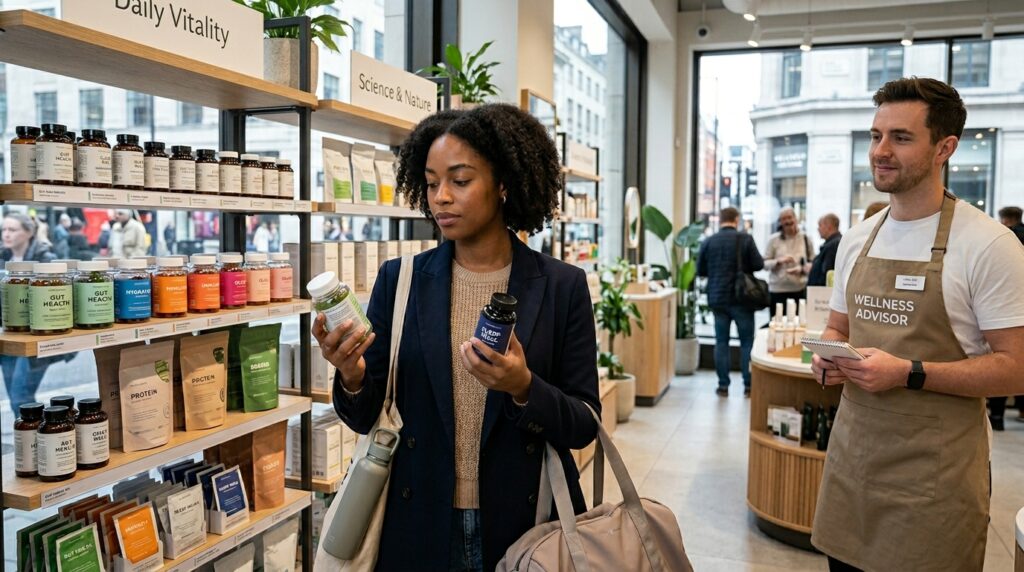

A market once driven by celebrity launches and social-media trends is increasingly being reshaped by convenience, clearer functional claims and consumer demand for products that look more like everyday lifestyle tools than complicated health regimens. :contentReference[oaicite:0]{index=0}
The supplements business is entering a new phase, one in which novelty alone may no longer be enough.
After several years in which vitamins, powders and gummies were propelled by TikTok virality, celebrity founders and the broader boom in “wellness” as personal branding, the competitive edge is shifting toward something more restrained: products that are easier to use, simpler to understand and more explicitly tied to a specific purpose. Vogue, in a report published this week, described an industry moving away from selling on trend and toward formulations that emphasize efficacy, convenience and scientific substantiation. :contentReference[oaicite:1]{index=1}
That shift matters because supplements have become far more mainstream than the industry once was. The Council for Responsible Nutrition’s 2024 consumer survey said three-quarters of Americans use dietary supplements, while McKinsey has described wellness more broadly as a $1.8 trillion global market in which consumers increasingly expect effective, science-backed solutions. What was once a niche category associated mainly with athletes, bodybuilders or health purists now sits inside a much larger consumer culture built around preventive health, beauty, longevity, sleep, gut health and everyday energy management. :contentReference[oaicite:2]{index=2}
The result is a crowded field. New brands still arrive with slick packaging and large ambitions, but they are competing in a market where consumers have already seen the first wave of hype. In that environment, presentation still matters, but clarity matters more. Products that promise everything at once are giving way to a more focused pitch: one product, one problem, one daily ritual. Vogue pointed to newer companies trying to stand out by offering formulas with a clearer function and formats that fit more naturally into busy routines, including gummies, powders and drinkable products. :contentReference[oaicite:3]{index=3}
That emphasis on usability is not a cosmetic detail. It goes to the heart of why many supplement brands struggle to build repeat customers. Traditional tablets and capsules remain central to the business, but analysts say they are facing growing competition from delivery systems that better match how consumers want to live. Grand View Research said emerging formats are gaining ground because users increasingly want supplements that are not only effective but also convenient, enjoyable to consume and aligned with specific lifestyle goals. New Hope Network, citing Nutrition Business Journal analysis, likewise reported that powders, gummies and liquids are taking share from traditional pills and represent some of the category’s strongest growth areas. :contentReference[oaicite:4]{index=4}
That is consistent with a wider pattern inside wellness culture. Consumers do not just want to “take a supplement.” They want products that integrate into an already crowded day. A powder can be added to a smoothie. A drink can replace a habitual afternoon purchase. A gummy can feel less clinical than a pill bottle. Vogue Business’s beauty and wellness tracker, produced with Spate, noted rising interest in formats such as creatine gummies, ashwagandha gummies and cortisol-support products, arguing that the appeal lies partly in making supplementation feel easier to integrate and more lifestyle-friendly. :contentReference[oaicite:5]{index=5}
This is also where branding and science are beginning to meet more directly. The supplement aisle increasingly borrows the language and aesthetic cues of skincare and beauty: clean design, active ingredients, benefit-led packaging and routines built around consistency rather than occasional use. But unlike skincare, supplements carry a special burden. They are ingested, not applied, and their claims are often harder for consumers to evaluate on their own. That makes trust more important.
The market is responding in two ways. First, brands are leaning harder on “science-backed” positioning, highlighting clinical studies, bioavailability and clearly named ingredients. Second, consumers are becoming more selective about what kind of proof they will accept. McKinsey said wellness shoppers increasingly expect data-backed and effective solutions, while Vogue framed the next stage of the supplement battle as one in which trust, scientific grounding and thoughtful innovation could matter more than simple online visibility. :contentReference[oaicite:6]{index=6}
Still, the phrase “science-backed” remains slippery, and that may become one of the defining tensions of the market’s next chapter. The U.S. National Institutes of Health’s Office of Dietary Supplements notes that clinical trials and other human studies provide the most direct evidence of a supplement’s effects, while also pointing consumers toward fact sheets, PubMed and FDA resources to evaluate claims. In other words, the scientific standard exists, but it is unevenly communicated and not always easy for shoppers to judge in a market built around rapid branding cycles. :contentReference[oaicite:7]{index=7}
That creates an opening for brands that can simplify without overselling. Consumers may be tiring of maximalist stacks and cluttered routines. Vogue’s reporting suggests newer entrants are betting that the future belongs less to the medicine-cabinet approach and more to a handful of products that do one thing clearly and fit naturally into daily life. In commercial terms, that means less emphasis on broad aspiration and more on practical outcomes: sleep support, gut health, hydration, hormonal balance, recovery or beauty-from-within. :contentReference[oaicite:8]{index=8}
The growth of drinkable wellness is especially telling. Vogue reported last year on the boom in functional drinks, linking it to what trend forecaster WGSN called “soft wellness,” a form of health consumption that feels less punishing and more pleasurable. That concept helps explain why the line between supplements, beverages and lifestyle products is becoming harder to define. A powder stirred into water, a collagen sachet or an adaptogen drink can be sold less as treatment than as ritual. The supplement is no longer just a product; it becomes part of a morning routine, a gym bag, a desk drawer or a beauty shelf. :contentReference[oaicite:9]{index=9}
This convergence with everyday lifestyle may be one reason the sector continues attracting investment even as consumers become more skeptical. Wellness has moved from the margins of consumer culture to the center of it, and supplements are one of the most easily monetized parts of that shift. They promise recurrence, personalization and emotional stickiness. A product that feels like part of a daily identity is more powerful than one purchased only in response to illness.
Yet with that opportunity comes a higher bar. As the market matures, convenience alone will not be enough, and neither will influencer backing. Survey and market data suggest consumers are more informed, but also more demanding: they want pleasant formats and clean design, but they also want functional logic. Analysts tracking the category increasingly describe growth not as a simple expansion in pills and capsules, but as a reordering of the entire delivery-format landscape. :contentReference[oaicite:10]{index=10}
The likely winners, then, may be the companies that can combine four things at once: targeted formulation, believable evidence, user-friendly design and repeatable daily use. That does not mean the industry is abandoning trend-driven marketing. On the contrary, social media will remain central to discovery. But the center of gravity appears to be shifting from spectacle to retention. Getting a consumer to try a supplement is one challenge. Getting that product into a lasting routine is another.
There is a broader cultural point here as well. The supplement race is changing because wellness itself is changing. It is becoming less about occasional self-optimization and more about embedding health aspirations into ordinary consumption habits. The language of “lifestyle” is not replacing the language of health; it is absorbing it. A gummy, powder or drink works in this context not only because it is easier to consume, but because it feels less like medicine and more like modern self-management. :contentReference[oaicite:11]{index=11}
That makes the current moment more consequential than it may first appear. On the surface, the shift from capsules to gummies or drinks looks like a packaging story. In reality, it signals a deeper redefinition of how health products are sold and understood. Supplements are no longer competing only on ingredients. They are competing on friction, credibility and cultural fit.
For the industry, that means the next race is not simply about who can launch fastest or market loudest. It is about who can make wellness feel simple enough to keep, useful enough to trust and ordinary enough to become part of daily life. :contentReference[oaicite:12]{index=12}